
In its appeal, the doctors' body said the government should promote universal free vaccination to all above 18 years of age without leaving the vaccines to the extent of 50 per cent to the states and private hospitals.

Fitch Ratings director Thomas Rookmaaker said India's debt-to-GDP ratio is likely to rise to 76 per cent from 70 per cent currently due to wider fiscal deficit and low economic growth.
This will cost the government Rs 3.1 trillion, about 10 per cent of its annual expenditure, and higher than any other spending item in its Budget.
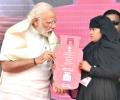
According to BJP strategists, PMJAY and the PM Ujjwala Yojana will form the nucleus of the Modi government's re-election campaign.

He said the people of the state took a historic decision in 2003 by removing the government of "Mr Bantadhar", apparently referring to senior Congress leader and former chief minister Digvijaya Singh.

Apart from Bihar, Chhattisgarh and Jharkhand, where none of the estimated 6.7 million construction workers got cash transfer benefits, the coverage of the construction workers was the lowest in Delhi, where only about 5 per cent of the estimated workers received cash under the PMGKY, followed by Kerala and Uttar Pradesh (22 per cent), among major states. In India, construction workers belong to the unorganised sector but account for the highest share of non-farm jobs after manufacturing.
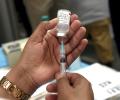
Union Home Minister Amit Shah on Monday expressed concern over vaccine hesitancy in some communities and urged people to spread awareness about the benefits of inoculation to win the battle against coronavirus.
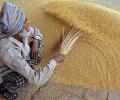
India's opening stocks of wheat in the central pool are expected to be 19.5-20 million tonnes as on April 1, 2022, the lowest in the last three years, but much higher than the normative level required for maintaining a buffer and strategic reserve, trade and market sources said. In accordance with the buffer and strategic reserve norms, India should have a wheat stock of 7.5 million tonnes in the central pool as on April 1 each year and this year's stocks, though the lowest in the last three years, will still be over 160 per cent more than what is required. On the export front, both government and trade sources are unanimous that this year (FY22) they will be 7-7.25 million tonnes, a record, while in the next financial year, they might touch even 10 million tonnes if the current momentum is maintained.
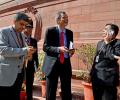
'We now look at divestment as an opportunity for maximising the value of public assets, not necessarily as a short-term resource-raising measure.'

With the world's worst outbreak of COVID pandemic stalling a nascent economic recovery, the government has begun assessing the impact of the second wave of infections on different sectors and may look at providing support at an appropriate time to segments requiring fiscal help. Some of the economic indicators, including the Goods and Services Tax (GST) collections, still provide confidence and incoming data will throw some more light on the state of the economy, sources said. Services sectors like hospitality, tourism and aviation which had just started recovering were hit hard by the second wave of COVID, the sources said, adding these segments might need some support on an urgent basis from the government.

March requires 20% jump to meet year's goal; CBDT chief tells staff to sweat it out to meet target

The I-T department will rely on data analytical tools and run models to separate black money holders and genuine taxpayers based on the large data base being shared by banks.

Gadkari said, infrastructure sector including highways, airports, inland waterways, railways, logistic parks, broad gauge and metro, apart from MSMEs can attract large scale foreign investment.
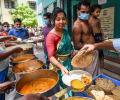
A decision in this regard was taken in the Cabinet meeting chaired by Prime Minister Narendra Modi.
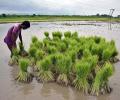
The area under paddy - the biggest foodgrain during the kharif season - was almost 13 per cent lower in the week ended August 5 as compared to the same period last year despite a slight pick-up in rains in the main growing regions, triggering fears of a 10-12 million-tonne drop in final output. Sources said with the peak sowing season for paddy almost coming to an end in the big-growing states, any uptick in coverage from here onwards may not give the desired yields. With 30 per cent of normal average area in which paddy is grown every year remaining unsown till early August, there is a limited chance of a big uptick in output, trade and market sources said.
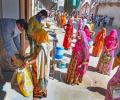
The government's food subsidy in the ongoing fiscal year is expected to be a little less than Rs 4 trillion.

This is the full text of the address to the nation by President Droupadi Murmu on the eve of India's 78th Independence Day.
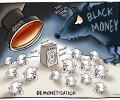
Tax wing scanning cash deposits between Rs 5-10 lakh

I-T heat on thousands of firms for unusual cash deposits.

The prime minister held a meeting with chief ministers via video-conferencing, and said it was imperative to work on war footing, identify hotspots, encircle them and ensure that coronavirus does not spread out.

In the coming few weeks, agriculture markets in North and Central India will be full of wheat, mustard, and chana - the three main rabi crops grown in these parts. Not only will the price trajectory of these determine the course of food inflation in the months to come, but it could also have a wider impact on the rural economy in the main growing states for these crops. Wheat and chana are largely grown in Madhya Pradesh (MP).

Is it a case of poor targeting of a welfare scheme, or is it a reflection of the government's desire to expand the scope of this benefit to secure greater electoral dividends? asks A K Bhattacharya.
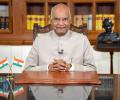
"All corona warriors deserve high praise," Kovind said in his televised address.

'The decision to supply free food grains is not an economically sound decision because the government will find it very difficult in future to charge anything for food grains.'

Prime Minister Narendra Modi's announcement of providing free inoculation to all adults will entail total spending of anywhere between Rs 45,000 crore and Rs 50,000 crore. This is higher than Rs 35,000 crore that the government had budgeted.

'It has been an ongoing process, talking to the relevant ministries about eliminating leakages and curbing non-core expenditure in various schemes.'

However, two districts -- Pilibhit in Uttar Pradesh and Shaheed Bhagat Singh Nagar in Punjab -- which did not record a fresh case in the last 28 days, reported new COVID-19 cases on Monday, it added.
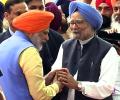
Whether it was the MGNREGS or the NFSA or the Aadhaar-based DBT scheme for cash transfer, the Modi government has built on the basic architecture created by the Singh government. Policy makers in the Modi government, instead of discarding them as products of the previous political regime, worked on them, expanded their scope and reach, and used new tools to improve their performance, explains A K Bhattacharya.

Both prime ministers believed in crafting schemes to help the common man. Modi used quite effectively the instruments Dr Singh introduced. In assessing Modi's success with many schemes, Dr Singh's fundamental work should not be ignored, points out A K Bhattacharya.

Includes those dealing in high-value property and petrol pump owners
The Supreme Court on Wednesday said there must be a "debate" on the "serious" issue relating to the practice of political parties promising freebies and asked why cannot the Centre call for an all-party meeting on it.

While the central bank had publicly cited only Rs 15.55 trillion of high value notes were cancelled, in an RTI reply to PTI, it had said the actual quantum of bills cancelled was much higher at Rs 20.51 trillion.

'We have not issued notices randomly.' 'We have done the risk profiling of individuals, and sent to those whose profile has not matched with their declared income.'
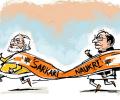
The situation could become more acute as millions of migrants who had returned to their villages during the lockdown come back to the towns for higher wages and better livelihoods.

The excise duty cut will translate into a reduction of Rs 9.5 a litre on petrol and Rs 7 a litre in diesel after taking into account its impact on other levies.

The economy could return to 8% growth by the end of 2017-2018, says Arvind Panagariya, vice-chairman NITI Aayog.

Why did Karnataka's economic prosperity fail to influence the nature of electoral promises made by political parties in the run-up to the assembly elections? asks A K Bhattacharya.
Apart from this, employers may be allowed to deduct EPF contributions only on the basic pay of up to Rs 15,000, even if the employees' basic pay is above this ceiling. While on one hand this will allow companies to lower their wage bills, employees can also get a higher salary in hand.

Finance Minister Nirmala Sitharama on Thursday stated the government is planning to provide a relief package of Rs 1.7 lakh crore to the underprivileged, poor and migrant workers affected by the lockdown amid the coronavirus outbreak. The scheme has been named the Pradhan Mantri Garib Kalyan Scheme.

The official twists and turns have raised questions on the government's credibility and its ability to pull the nation out of the demonetisation quagmire. To keep up with the new rules, the government has issued an updated FAQ on demonetisation.
 © 2026 Rediff.com - Advertise with us - Disclaimer - Privacy Policy - Sitemap - Feedback - About us - Terms of use - Grievances